Feb 21, 2011

Labor of Love: Dog Visits Patients, Including a Novelist

By Cathy Scott

A black dog named Cypress walks down the hallway toward a hospital room, wagging his tail, then stops, waiting for the go-ahead.

“Hi, Richard,” says Melanie Meacham, the dog’s person, as she taps on the opened door. “Do you want company today?”

“Yes. Come in, buddy,” the voice of the patient says, speaking directly to Cypress.

With that, Cypress, a lab mix, walks in, stealthy jumps up on the bed and gently lies beside Richard Steinberg, a writer and novelist, for their long visit.

And so it is through the course of those regular visits that a K-9 therapy dog and a patient have formed a special friendship.

“Do you know what it means to have dogs like Cypress visit?” Steinberg asks. “He and I have a bond. He doesn’t want anything from me, except the occasional treat, which his Mom provides. There’s a trust between us.”

That trust translates to gentle playing between the two, along with hugs, as Cypress spreads out on the bed. Then, Cypress inches closer. “Come here, boy,” Steinberg beckons, and Cypress rests his head on Richard’s chest.

On a book case in Steinberg’s room is a framed photo of his German shepherd, Dolly, who has passed away. “Dogs are like children,” he says. Steinberg, who writes New York Times’ bestselling thrillers, is younger than most of the other patients at the center. But the words are not coming as easily these days, he says, at least on a keyboard, because of several strokes. When it comes to talking about his books, however, he is still quite articulate. And when it comes to Cypress, words aren’t necessary. The two simply gaze at each other like long, lost friends.

Once he leaves Steinberg’s room, 3-year-old Cypress heads down the hallway to see Benjamin Bennett, also a patient, who’s sitting in an armchair, waiting for him. Cypress rests his back against Bennett’s legs while Bennett gives him a neck rub.

“He always remembers me,” Bennett says.

And so it goes each Tuesday and Thursday when Cypress and Meacham stop by Marquis Care, a rehabilitation center, to see patients who need specialized care after an illness or injury. Cypress, who is a certified therapy K-9 with Delta Society Pet Partners, and Meacham are a team.

Besides Marquis Care, they also volunteer for “I Read to Animals” events at libraries through Best Friends’ Education Ambassador program.

To stay in shape between gigs, Cypress, whom Meacham adopted from Best Friends’ sanctuary, regularly takes him to a local dog park. Coincidentally, while there, Cypress and a dog named Ash began playing with each other. When Meacham and Ash’s person, Julie Tuiofea, began chatting, they soon realized that Cypress and Ash are actually brothers, from the same litter, who were born in the Gap, a Native American reservation, and rescued with the mama dog.

Today, the pair are best friends and play nonstop when they meet in the evening at the park.

Cypress, says Meacham, who works for the local police department, “came to me a shy, wimpy, underweight dog. He wouldn't drink from the water bowl without me being there, by his side, and he would cower at just about everything and every word." Still, she says, he wanted to be with her. “He wanted that human touch,” she says. “He just needed a loving and safe home where he could grow and learn to be more confident.”

Cypress made fast strides, with the aid of Meacham’s smaller dog, Charlie, and patience on Melanie’s part.

Today, he’s confident and friendly and enjoys visiting patients. “He really does love everyone,:” Meacham says.

But don’t call it work for Cypress, as Meacham points out. “I noticed he had a sweet approach to everyone he met, that he had a natural way of putting people at ease. I thought Cypress might just make a great candidate for therapy work and maybe a reading program.”

She was right. To her, Cypress represents more than a successful adoption. “He represents the truth that exists when you recognize that all creatures deserve an opportunity to be themselves in a home that accepts them for who they are.”

Even further, she points out, whether he’s at a library being read to by children or at a care center visiting patients, “It is just in Cypress to be with people. If you need him, he needs you. No work is involved.”

Reprinted from Best Friends Animal Society.

Feb 8, 2011

Childhood Pets

My sister, Cordelia, came across these photos, of Penny, a beagle mix, and Puff, a long-haired tabby cat.

We adopted Puff–after much begging to our mother–from a family friend when we were in junior high school.

These are the only photos left in the family album of the two. In the first photo, Penny's drinking water from our family swimming pool.

Penny was the best dog, adopted from the San Diego county shelter, with my Dad, when she was an older puppy. I named her Penny because she was the color of a penny. She smiled, lifting her lips, on cue–literally–and was smart as a whip. I took her to obedience school to learn how to walk on a leash and sit and stay. The trainer wanted me to buy a choker collar for her, but even then, I knew somehow that wasn't right, so I didn't do it.

I took her to the beach, when dogs could still go there, and on outings. She loved to ride in the car.

Puff was a cool cat, back when people let them outside, when it was safer. She'd sit in our driveway, waiting for us. She'd sometimes sleep on our beds at night. She was just around. She and our first dog, Nosy, agreed to disagree and ignored each other. And Penny ignored Puff too.

Thought I'd share the only photos we have.

Feb 2, 2011

On the Trail

By Cathy Scott

I took in a late-afternoon hike with my dogs on my birthday (Feb. 1). Great hike, and they loved every minute of it. It was cold for me, but not for them. It was just before the sun fell behind the hills in Red Rock Canyon, in Calico Basin. The colors were magnificent. Enjoy the pics!
Rosy, making her way up the trail.
 
 Rosy trudging along (she turns 11 on Valentine's day, but she still does great on hikes).

 Hollywood, very much in his element.
 Woody powering out on the trail, toward the end.
 Joey, before I let him off lead (his first time in the canyon without a leash).
 Rosy with ears flapping in the wind!
 Joey catching up with Hollywood and Rosy!
 Gypsy and Joey, on the flat rocks.
 Woody, leading the way!
Joey walking down from a cliff and heading back, at the end of the hike. It was a good one.

Dec 16, 2010

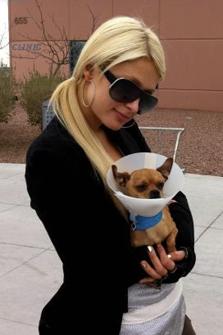
To Paris, With Love: Rags-to-riches story as Paris Hilton adopts shelter dog, encourages others to do same

Paris and Sid at shelter
By Cathy Scott, Best Friends staff writer

A tiny Chihuahua named Sid has gone from living in an animal shelter in Las Vegas to life in Mulholland Estates in Los Angeles with Paris Hilton. It marks the first time the celebrity has adopted a dog instead of purchasing one from a pet store.

Hilton chose the Lied Animal Foundation, a municipal shelter in Las Vegas, for her community service, per the terms of a plea agreement for a misdemeanor offense committed in Las Vegas. This week, while Hilton spent the day helping at the shelter, she met the 3-year-old former stray and made an instant connection. She arranged to adopt him and, the next day, after Sid had been neutered, which the shelter requires, she returned to take him back to Los Angeles. Sid now lives with Hilton’s two other dogs, a Yorkshire terrier and a Chihuahua.

Hilton commented on Twitter about her work at the shelter, saying, “Volunteered all day at Animal Foundation. Made me cry to see animals needing homes. Adopted a dog today. So sweet.”

According to the Animal Foundation's website, its adoption fee is $155 and includes vaccinations, neutering and a microchip ID. It’s quite a switch from just three years earlier when Paris bragged to an entertainment reporter about buying a tiny dog at a boutique pet store, which was one of the shops Best Friends volunteers rallied at to inform consumers that the puppies in that store came from puppy mills and substandard conditions. The store has since closed its doors.

For Kelli Harmon, campaign specialist for Best Friends Puppies Aren't Products, Hilton’s adoption is hopeful news. “Paris' love for animals has influenced many young people who see her with a tiny Chihuahua and then go buy one for themselves,” Harmon says. “As a fellow Chihuahua adopter, I wish her the best and hope she and her new little one will influence people the same way she has in the past, but that now people will head to the shelter instead of a pet store to find an adorable new pet.”

By the looks of it, Hilton does intend to set an example for others. After she left the shelter, she encouraged her followers on Twitter to adopt rather than buy a pet, writing, “This Christmas, if you’re thinking of getting a dog or cat, get one at your local animal shelter. Save a Life. Don't Shop. Adopt,” and, in a third tweet, “Remember, a dog is for life, not just for Christmas.”

Reprinted courtesy of Best Friends

Nov 25, 2010

Happy Thanksgiving for Turkeys Apple and Cider

By Cathy Scott
Presidents have been pardoning turkeys on Thanksgiving eve for years, and this year is no different. President Barack Obama, on the Wednesday before Thanksgiving, pardoned a pair of turkeys, 21-week-old Apple and Cider. They will live out their days at Mt. Vernon.

In the past, pardoned turkeys have gone to Disney's California and Florida parks and a Virginia farm. This year, they're going to live with livestock at Mount Vernon, the home of the first President, George Washington, near Alexandria, Virginia, on the estate that once was a plantation.

Mount Vernon
"As President of the United States," Obama told the turkeys during the ceremony, "you are hereby pardoned from the Thanksgiving dinner table. May you have a wonderful and joyful life at Mt. Vernon."

A custom-made pen was tooled and ready for the turkeys, who were to arrive at Mt. Vernon by a horse-drawn carriage  and greeted with a trumpet fanfare.

Obama with Apple
It's only fitting. After all, it was George Washington who, in 1789, issued a proclamation for a National Day of Thanksgiving.

To commemorate this year's day of Thanksgiving, Apple, with Cider as the understudy, was officially pronounced the National Thanksgiving Turkey, and both were spared.

Nov 13, 2010

It's Official: Puppy Mill Bill Passes

Gypsy the day she was rescued
By Cathy Scott

When I learned the news, on the night of Nov. 2, that the so-called "puppy mill bill" in Missouri had passed, I was elated. That's because sitting next to me was my former puppy mill girl Gypsy. As I wrote an article for Best Friends Animal Society's Web site about the passage of the initiative, which has been called historic, I stopped a few times to both congratulate and hug Gypsy.

I firmly believe that we'll eventually look back and say that Nov. 2, 2010 was the day the puppy mill industry forever changed, and for the better. The bill requires clean water and fresh food, no more than 50 breeding dogs per puppy mill, and no more wire-bottomed cages. Nearly a million Missourians voted "Yes."

It was a year ago this month--November 2009--that Gypsy Rose Lee was pulled from a large puppy mill. She'd had three puppies the week before, and one, two or even all three may still be in that awful place, used as breeders for profit, like my Gypsy.

Gypsy & volunteer Tara Albert
Gypsy is a seven-pound long-haired Chihuahua and as cute as she can be. But the day she arrived at the temporary rescue center, there was a deep sadness in her eyes. She arrived in a carrier with a tiny Pomeranian. They seemed so connected to each other. But, other than arriving from the same puppy mill, they may have never before met each other. In that short time, a few hours in a carrier together as they were transported from a mill by an independent rescuer, the two little dogs had bonded; it was as if they were leaning on each other for support during this scary time. After all, the outside world was all new to them, and they didn't know where they were going or why. Gypsy had lived 2-1/2 years in a wire cage with several other dogs in the only environment she'd ever known.

She had been bred in two different puppy mills, the first of which--a large one--has been listed on HSUS's worst list. She was born there, kept as a breeder instead of leaving with a broker to be shipped cross country to a puppy store. She had one litter by Cesarean section, and the breeder took her to auction to be sold. There, Gypsy was purchased by another breeder, this one a smaller operation with about 200 breeding dogs.

Puppy mill dogs
Gypsy, in early November last year, had a second litter. Once again, they had to take her puppies by C-section. Gypsy didn't nurse her puppies, so they were given to another mama dog. And Gypsy had an infection, so the breeder rejected her. Luckily for Gypsy, an independent rescuer was able to rescue Gypsy and take her to the Best Friends temporary center, through the Puppies Aren't Products program, where Gypsy was one of around 190 dogs fostered by individuals, groups and shelters. And I was lucky enough to be able to take Gypsy home with me. I had her spayed within two days, because she had an infection, a fever and things were not going well. On top of that, she has knee problems (inoperable, because her femur bones are bowed, but keeping her walking and with a good weight helps to ease it).

Gypsy on my lap
Gypsy has adjusted well to her new home. She loves other dogs and fits in well with my crew. Behavior-wise, it's still like she's still anxious and waiting for her new life to end, as if it can't be true that the one she left behind has ended. She continually paws at me--a common trait, which puppy mill dogs get into the habit of doing to the front of their cages. She sleeps against my back each night. I try and reassure her that all is well and nothing is going to change.

She loves her walks and stops to smell nearly every bush and blade of grass as we pass by, because she's fascinated by everything in her new world. She also loves car rides. She's still really shy with new people, won't make eye contact and looks worried when other people hold her.

While I continue working with her and giving TLC, I also just let her be a dog and hang out and do what she enjoys. She deserves no less, as do others still stuck in puppy mills. She loves chewies and practically prances around with them in her mouth.

To all the Gypsys of Missouri still used for profit, hopefully their day too will come sooner than later, now that Proposition B is the law, and they too can get to know the true life of a dog.

Sep 6, 2010

Rock Solid Memories

By Cathy Scott 
Reprinted courtesy of Best Friends Animal Society 

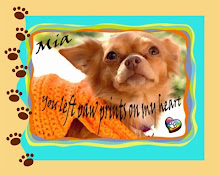
Glance at a painting of a dog named Mia, and her eyes appear to be looking back at you, glistening. Mia is one of the animals now memorialized on painted rocks. Walk around Angels Rest memorial park at Best Friends Animal Sanctuary, and you will see a sampling of those painted rocks.

They’re the work of volunteer Linda David, who has painted more than 1,300 rocks for Best Friends. As Mary Pat Dutton, who worked at Angels Rest until recently, said, “She does it as a hobby that has turned into a labor of love.” 

Mia was my dog, rescued from four feet of water by a Best Friends team in the Gulf following Hurricane Katrina. She passed away from heart disease in 2009 and is buried at Angels Overlook on the Sanctuary grounds. Now, thanks to the generous artistry of Linda, when I look at Mia’s rock, her brown eyes appear to look back at me, her face has that same pouty look she often wore, and it’s like a piece of her is with me again. She was an old soul, and that too was captured in Linda’s portrait. 

“That is my favorite part to paint--the eyes--and I have to put them in near the beginning, and then they start to come alive to me,” she says. “When I see a picture of an animal, I know instantly if I want to paint it. Usually the eyes speak to me, and with a story such as Mia's, I always hope it will find its way to someone who will cherish it."
 
Cherish it, I do, as do others who cared for pets who are now memorialized on stones.

When she finished the latest paintings of animals, Linda suggested they be offered to the employees for whom these animals were extra-special, which is how I was given Mia’s rock. The others were placed at the head of their graves, complimenting the atmosphere at Angels Rest, where, as you walk around to view the graves and the rocks, you hear the sound of 900 chimes in the wind. 

The comments Linda gets back about her paintings is what makes it all worthwhile. “It is so nice to hear from people and to know how much they are enjoying the rocks,” she says. “That is why I do it.”Hand Painted Memorial Rocks 

She’s also done paintings of some of the animals who are still with us, like Georgia. Her story particularly touched Linda, which is why she chose to paint her image. “Georgia is one of the Victory dogs who have gone through so much and can still have so much love in their hearts. That is so amazing to me. They have such inspiring stories that we can all learn from,” she says. 

She also paints a variety of portraits as well as rocks with just the names of the dogs, cats, rabbits, potbellied pigs, horses -- you name it. “Some are the portraits of specific animals, some breeds, and some have things such as hearts and butterflies and names on them,” she says. 

Linda, who had a grooming career for many years, has always loved animals. Once she retired, she was a pet sitter for a few years. “Now I am enjoying painting the rocks, which I started about 10 years ago. I had watercolor lessons many years ago, and my teacher was very inspiring,” she says. Linda and Terry David 

In exchange for her artistry, it’s the response from the people who cared about the pets that is payment enough for her artwork. “One of the biggest compliments I've ever gotten was from a man who lost his dog, Lobo,” Linda says. He said if his house was ever on fire, his Lobo rock would be the first thing he would save. That's all the thanks I need.”

Photos by Molly Wald

Sep 4, 2010

Nosey and Me

Nosey, in a doll stroller, with Cathy (or is that Cordelia?)
By Cathy Scott

One of my earliest memories is the day our family got a dog. We named her Nosey because she sniffed all around the yard and house when she first came home. She was a pound puppy, and she was loyal. 

My twin sister Cordelia and I were 3 years old. I remember one Saturday morning running outside to the front yard and standing there in anticipation as our father pulled up to the curb. He had left that morning for the county pound, but we didn't know it. All we were told was he was coming home with a surprise. At the time, we lived in the Valencia Park community of San Diego, and our street was loaded with kids. Some were there with us, waiting.

Dad walked around to the passenger side of the car and opened the door. I've never forgotten it. Nosey practically fell out of the car, but I'm sure my Dad had carried her down. She didn't have a leash on, but she didn't go anywhere. All five of us -- my brothers and sisters -- started fawning over her. She was the cutest, sweetest little short, black-and-white puppy with floppy ears, part beagle, part Basset hound. I've loved short dogs ever since. 

When we moved to La Mesa, a suburb of San Diego, we lived on a cul-de-sac, and Nosey was always outside with us. When we played softball in the traffic circle, she'd stay on the sidewalk as we played. I remember hanging out at our friends' house (Vickie and Sharon, who lived down the street), and Nosey would sit on the lawn in their front yard, waiting for us to come out.

When I was 7, our father won a trip to a convention in Jackson Hole, Wyoming. We drove there, stayed a week, and then went for another week to Missouri, where my father grew up. We left Nosey with family friends, who lived 10 miles away. A couple days into it, Nosey got out and ran away. They looked everywhere and couldn't find her. The father decided to check our house. Sure enough, Nosey had made it home and was hiding in a corner of our basement. He left her at our house and went back each day to check on her and feed her. Nosey had never before been to their house, so it amazed us all that she had found her way home. She was there to greet us when we returned. 

When Nosey contracted hepatitis shortly after we moved to La Mesa, when we were still in grade school, the five of us, without our parents, took her to the vet. My brother Michael, the oldest and probably 17 at the time, carried her across the canyon behind our house that led us straight to the nearest veterinary clinic. The vet gave us medicine and said she had to stay there, because she was too sick to go home. He wasn't sure she'd make it. All of us said no, that she was coming home with us. We instinctually knew she had a much better chance at home. And we were right.

Once home, we laid her down on the living room floor on a blanket, where she stayed for about a week, barely moving except to eat some and go outside. I remember that first day, laying my head on the carpeted floor next to her, petting her, and Nosey growling. She wanted to be left alone. So that's what we all did; we gave her space. Within a week, she appeared to be well on the road to recovery. In no time at all, she was back to herself. That illness was probably the only time she ever growled at any of us.

Nosey passed away at 15 years old after suffering a couple of years with arthritis. Even back then, our mother used a natural remedy for arthritis, but at the time we didn't know it was holistic. She had read somewhere that cod liver oil eased the swelling in joints, so she put it on Nosey's food. Nosey was then able to walk up the porch steps for the first time in a long while. It helped for a time until she could no longer move around easily. And she was loaded with either tumors or fatty deposits. To combat California fleas, we regularly put flea powder on her coat, which, back then, was in the form of diatomaceous earth, also natural. And every Sunday, Mother would cook a pot roast, and Nosey would get the bone afterward. Nosey would stand in the kitchen waiting for the bone, along with some carrots and potatoes thrown in for good measure.

Seeing Nosey as a puppy again in this photo brought back memories. Our mother always called her "the doggie in the window," so she must have been at a window when our father first saw her at the pound (much smaller facilities back then). No wonder all of us kids became animal lovers. Our dad made sure of that when he gave us a puppy -- and, later, Guinea pigs, a parakeet, hamsters, rabbits, fish, a cat, and a horse named Star. Nosey was a member of our family. I still miss her.

Aug 17, 2010

Loss of a Friend


I lost a friend over the weekend--a canine friend named Lizzie. She was my dog Molly's sibling. They were adopted separately at a Best Friends Animal Society event at PetsMart.

They were born in Orem, Utah, in the spring of 2000, in a back yard. The father dog was a red heeler and the mother, a basset hound. Eight dogs were in the litter; one was stillborn, three were adopted out by the people who had the mother dog, and the other four went to Best Friends.
I had gone to PetsMart that Sunday afternoon to buy cat food for my elderly cat, Tiki. I went home with a puppy, whose name at Best Friends was Princess Anne (whom I later named Molly). Lizzie was named Queen Elizabeth. Madison (adopted by Denise and Tony Meeker) was there too, as was King Charles (called "Chuck" by his adopter). Lizzy (with her blue-heeler coat, above, on a hike) was adopted by Patty Beard and her daughter Stephanie. (Yes, the dogs' original names had a British theme, because their caregiver, who was interning at the time at Best Friends' sanctuary, was from England.) 

Later, the adopters got in touch with each other, so the puppies could play together. When Lizzie and Molly saw each other for the first time after weeks of being apart, their first reaction was to growl at each other -- puppies showing dominance, was all. After that, they were inseparable. They had play dates and sleepovers and hikes together. And they played at the dog park with their friend Sierra, also a puppy the same age, and Eddie, Angel and Bella too. They all grew up together. The littermates even had a first-year birthday party, where all four siblings and some of their canine friends got together to play and eat treats.

Once, when Molly and Rosy (my other heeler-basset mix) had a sleepover at Lizzie's, Patty and her husband had set out frozen beef in three large packages, so it could thaw on the kitchen counter. It was for a family back-yard barbecue, with beef strips, they were having the next day, on Memorial Day. Somehow, these three short dogs were able to jump up and retrieve the packages from the counter. By the time Patty arrived home a few hours later, the meat had been eaten and all that was left -- scattered around the kitchen and living room -- was the packaging, as well as three dogs who looked quite proud of themselves.

On Saturday, August 14, Lizzie, at 10 years old. passed away, possibly from the same thing as Molly two years earlier -- hemangiosarcoma, the silent killer, which goes undetected until it's too late. Lizzie had a mass too. And the symptoms came on suddenly, just as with Molly.

I've always said that Molly (with Lizzie, left) was a heeler trapped in a basset body. But Lizzie was smaller and in better proportion than Molly. And although Lizzie was short like Molly, she was more like a midget heeler, and a fast one. Most of all, she was very sweet and affectionate -- and smart to boot.
The last time we saw Lizzie was three years ago, right before Patty and her husband moved her to Missouri. We met at a dog park to say goodbye, and when Lizzie saw Molly, she started barking her loooong basset bark, practically howling with glee. She and Molly ran and wrestled and chased each other until they dropped on the grass from exhaustion. I had a sense that it would be the last time they'd see each other, but I thought it would only be because of the physical distance between them, not because of a disease or illness that would take them both away.

In Missouri, Lizzie had a new sister, a Corgi pup named Spankee. There, Lizzie loved running free on her large property with Spankee. Lizzie had a favorite tree where she lived, and she liked to sit under and rest there. Now, Spankee sits under that tree.

When Patty said her goodbyes to Lizzie on Saturday, she talked to her and told her she loved her, and that Spankee loved her too. And she also said, "Now you'll be able to run and play and be with Molly again."
Theirs was a lengthy friendship between sibling dogs who didn't live in the same house. But Molly and Lizzie truly loved each other, and it was a genuine bond. Wouldn't that be a hoot if they were together again, chasing each other on grass, trying to wrestle away a tennis ball from the other?

May 23, 2010

You Can Go Home Again


"How far we all come. How far we all come away from ourselves. You can never go home again." 
--James Agee


My friend Barb Davis, a photographer in her spare time, shot this beautiful photo of Mia (above) that I just had to share.

The photo was taken in New Orleans when Barb, Carol Guzy and I were there for Best Friends Animal Society's participation in the annual Barkus Parade (a part of Mardi Gras).

It was on that same trip that we took Mia to her previous home, to the American Can Co., a Mid City apartment complex converted from a factory and from where Mia had been rescued.

No one had come forward to claim her, even though her face and her story were on the Internet pretty much everywhere. She was listed on Petfinder as well.

When we pulled into a small parking lot at the front of American Can Apartments on Orleans Avenue, Mia sat up and looked out the window, her head darting in every direction. She looked up at the building, then looked back at me. I lifted her out of the car and she wiggled to be put on the ground. When I did, she practically dragged me on her leash up the steps to the main door. It was locked. She stood there looking up at it, wagging her tail, then looking back at me to open it.

It was quite a moment. Barb was right behind Mia as she pulled me toward the door. "It was so sweet," Barb said. "It was like she wanted to show you where she had lived."

We walked around the large complex of buildings to the back, from where Mia had been rescued on the swimming pool deck from four feet of water. It wasn't until the second rescue day at American Can that the rapid response team members Ethan Gurney and Jeff Popowich could get her and one other Chihuahua from a small corner of dry concrete they'd huddled on. The day before, Mia and two other Chihuahuas swam away from the rescuers.

Once we walked onto the patio deck, Mia wanted to be held. It was obvious she remembered what had gone down there, and her demeanor changed dramatically. She jumped up on my leg to be picked up, so I carried her the rest of the time. We returned to the front of the complex.

We didn't know at the time that Mia had just a little more than a year left to live. Reflecting back now, it was a fitting reunion for her, and a trip to the American Can I'm thankful we made. It was as if Mia had gone full circle, like visiting an old friend. She was home again, and she knew it.

As the five-year anniversary of Hurricane Katrina approaches, rescuers are having their own reunion in New Orleans. And Best Friends, to remember, is posting two stories a week on its Web site, beginning June 1, until the August 30 anniversary.


Who says you can never go home again? On a February day in New Orleans, Louisiana, Mia went home again. And she was happy for it.


My book, Pawprints of Katrina (above), covers Mia's and other stories about the tremendous animal rescue efforts, the largest ever in U.S. history. Read it here.

Photos by Barb Davis. Book cover by Clay Myers.

May 2, 2010

News About My Canine Family

Here are some new photos of my dog family. And I want to share the latest medical news about Rosy (my heeler/basset mix diagnosed 2-1/2 years ago with melanoma) and Gypsy (rescued from a Midwest puppy mill last November).

Gypsy and Rosy just had medical exams. First Gypsy (above). Her patellas -- knee caps -- both luxate. But because her femurs are  bent (a genetic defect), she's not a candidate for surgery.


So, the vet recommended I keep Gypsy exercised and at a good weight for the rest of her life so she doesn't have extra stress on her knees. Gyps conks out sometimes on walks, so the vet also suggested I build her up slowly, push her a little bit more each time until her little legs are more muscular and can take it.
 Now for Rosy (above, running). She has two new moles, one on her bottom and the other on the back of a rear leg. The one on her leg is growing fast, but it's a bright pink and the vet thinks it's a cyst. She wants to remove it anyway, because of Rosy's history. The other is new and in an awkward place, so it's a delicate surgery. I'm still giving Rosy Vitalzym every day, and I just doubled her dose. The vet said she was incredibly healthy for a 10-year-old dog diagnosed more than two years ago with melanoma. She shows no signs of having cancer, so I'm optimistic.

Then there's Joey, my shih tzu (above, left). He just had his teeth cleaned, and no extractions were needed! He's a little trooper and did well. He didn't feel very well, however, that first afternoon and evening. He whimpered a little and sat on my lap. Finally, he fell asleep. When he woke up the next morning, he was a new little man!

Finally, life is good for my big boy, Hollywood, right now, who turned 10 in January. Nothing medical is going on with him! He's lost some weight from all the walks we take -- and watching his food -- and does really well on two-mile runs with me. I think he could go on forever!


Apr 13, 2010

Natural Treatment for a Dog's Sniffles

My shih-tzu Joey's right eye is swollen again and he's congested; he has a rattle when he breathes, and his nose is congested and drippy. His eye was swollen when he was rescued more than a year ago, and it comes and goes.

So, I thought I'd try Vitalzym on him this time. I give it daily to Rosy, my basset-heeler mix, who has malignant dermal melanoma (and two-and-a-half years after diagnosis appears strong and healthy).

Vitalzym is loaded with systemic enzymes that -- as one Web site put it -- "act like little Pac-Mans that go around 'munching' mucus, inflammation, fibrin, viruses and scar tissue in the body."

I'm hoping it will work as an anti-inflammatory for congestion too. We'll see. Joey's been under the weather all day, so it might be allergies. The weather here in the Mojave Desert is up and down right now temperature-wise, plus it's been really windy. Fingers and paws crossed it helps. Will keep you posted!

Apr 9, 2010

Zoe Means Life

Reprinted from Best Friends Animal Society


By Cathy Scott

It’s a new day for a wire-haired fox terrier named Zoe.

Life was scary at first for this former puppy mill dog. After all, Zoe, who was originally named Cilantro, was born inside a Midwest puppy mill. For the next six-and-a-half years, she was used as a breeder. So, adjusting to life outside a cage was a lengthy process.

It wasn’t always smooth sailing for her adopters, Pamela Clifford and Lorrie Webb, either. In fact, they moved from a condominium to a house because of complaints from neighbors about Zoe and her bark. In a nutshell, adopting Zoe “uprooted our entire life.” But they’re not the kind of people to give up, especially on a dog.


Zoe and Kallie
Zoe and Kallie
It was late May 2009 when Zoe and more than 200 dogs - unwanted, used-up breeders - were rescued and transported to shelters on the East Coast where there’s a high demand for purebred dogs. Around 30, including Zoe, within that group went to Best Friends Animal Sanctuary.

Once at the sanctuary, shy Zoe was diagnosed with mid-level dental disease and her ears were inflamed and dirty. Around that time, Lorrie and her friend Patricia were at the sanctuary attending a workshop. One day at the sanctuary, they spotted Zoe and a cocker spaniel in a run together. They stopped to visit.


“We just had to have her,” Pamela said. A short time later, they returned to the sanctuary to finalize the adoption, and then headed south to La Jolla, Calif., where Zoe went to live with Kallie, a rescued shelter dog, and a cat named Little Girl.


Never having lived in a home, Zoe couldn’t seem to get the hang of housetraining. And, she was frightfully skittish.


That first week, Pamela took time off from work to be with Zoe. “She slept every day,” Pamela said. “Any movement terrified her. She would freeze in her spot. Every time I turned around, she’d freeze.”


Then Zoe was diagnosed with pancreatitis, an inflammation or infection of the pancreas. “We thought we were going to lose her. We went to emergency. We put her on antibiotics and changed her food to high-end dehydrated,” she said.


Also, Pam said, “She was a special-needs dog. I had no idea that it would be the amount of work it was and the patience it would take.”


The first time Zoe was groomed was an experience for everybody involved. “Who would have ever thought a small dog could take down three grown women?” Pamela said. “Oh, those nails she had.”


Next, “Our little Zoe started to bark” - so much so, they unfortunately learned, that when Pamela and Lorrie were at work, she barked nonstop. A few months later, they decided to move into a house in nearby Pont Loma, a coastal community in San Diego.

Life's a beach
Life's a beach
With hard work, patience and time, Zoe gained confidence - and manners. Ten months later, she now loves to take walks along the tide pools near La Jolla Cove, play with toys and wrestle with Kallie. “She’s not barking,” Pamela said. “We come home and everybody’s quiet and calm.”

She’s still a bit afraid of men but is learning to be bolder. When asked if Zoe had adjusted well to life in a home, Pamela said, “I don’t know if she’s well-adjusted or if we’re just in love with her.”


The love Zoe is getting is exactly what makes it all worthwhile for people like Kelli Ohrtman, a specialist for Best Friends’ Puppies Aren’t Products campaign who organizes and oversees the Pup My Ride program.


“The progress Zoe has made with her new family is what keeps us all going,” Kelli said. “Zoe - and the thousands of other dogs like her - is the reason this work is so important.”


“Until she was rescued through Pup My Ride,” Kelli continued, “her life was very small. She was confined to a small cage with no love, no playtime, no freedom to act like a dog. The transition from that small life to living in a home can be difficult. Even accepting love from humans can be difficult for dogs who haven’t ever been given that. But with time, patience and understanding, these dogs blossom.”


Seeing Zoe today “prance around with her friend, snuggle on the couch and run on the beach is the sort of happy ending that makes this work worth it,” she said.

For Pamela and Lorrie, they believe they’ve learned volumes from Zoe and gotten back more than they’ve given.

“If you’ve never seen resilience, she’s the epitome of it,” Pamela said. “Every day she [had] looked sad. It's remarkable she survived what she’s been through.”


Then, one day, a miracle happened. Zoe wagged her tail.


“The first time her tail wagged,” she said, “we were so ecstatic. We said to each other, ‘Look at that.’ It was like watching a baby take her first steps. Zoe is just amazing.”


Photos courtesy of Pamela Clifford and Lorrie Webb.


To view a video of Zoe and family, click here.

Mar 11, 2010

The Crew in the 'Hood


Sunday morning was sunny for about a one-hour window, in between the rain in the Mojave Desert. So I got everybody into their harnesses (above left-right, Rosy, Hollywood and Joey), and we hurried out the door for a walk in the 'burbs.

Gypsy (pictured left) lagged behind a bit, so that's why she's pictured by herself. Once, I tried her on a coupler -- two on one leash -- with Joey, but it was more like Joey was pulling her than she walking at her own speed. So I ended up carrying her most of the way.

She's not up to their level yet. After all, the Gypsy girl is a puppy mill survivor with a back leg that turns in from living in a cramped wire cage for two years. We'll try the coupler again another time. She's a trooper, though, and loves to go on walks. It took just two trips around our neighborhood for her to figure out that it was a really cool thing to do.

Gypsy now gets just excited as my other dogs when the harnesses and leashes come out and it's time to get "dressed."

Passers-by in cars sometimes slow down to look at the small, medium and extra-large dogs I'm basically steering down the sidewalk. Some even make comments like, "Boy, that's a handful." It looks like it, but they're not. They all know the drill, are great on leashes and love their walks -- and I have just as much fun as they do.