Showing posts with label Best Friends Animal Society. Show all posts

Jun 28, 2011

'Pup My Ride' Heads to Big Sky Country

Precious cargo consisting of 38 dogs makes 1,200-mile journey from Los Angeles shelter to new lives in Montana
 

By Cathy Scott
Reprinted from Best Friends Animal Society

It’s 8:30 in the morning, and caregivers are cleaning kennels and feeding animals. But, for three dozen shelter dogs, this particular Monday is anything but business as usual.

The staff at the Baldwin Park animal shelter is all abuzz with activity because Robin Harmon and a team of volunteers have arrived, which means it’s Pup My Ride day. Thirty-eight dogs have been chosen to leave the shelter for a trek to Montana on the Pup My Ride transport.

The dogs are walked or carried to a grassy play area to run off energy, chill some and take potty breaks before boarding the Pup My Ride van to a waiting rescue group in Montana. Watching them play and romp with each other, you’d never know they’d found themselves, for a variety of circumstances, inside the walls of a Los Angeles County animal shelter. Today, however, is their lucky day, and the dogs seem to sense the excitement in the air.

“This is Bambi,” says Robin, introducing what looks to be a matted poodle/bijon mix. “Bambi was a stray. He went to a [Best Friends] super adoption event but didn’t get adopted, so we rescued him from the shelter.” Robin heads up Pup My Ride for Best Friends Los Angeles programs, which rescues at-risk smaller dogs from shelters and takes them to rescue groups in other cities where there is a demand for dogs like them.

It’s Bambi’s turn to be walked to the play area, where he takes off running with some of his new canine buddies accompanying him on the two-day, 1,200-mile trip.

Also hitching a ride to Montana is Oreo (to the right), a tiny, friendly black-and-white puppy who sits in a dog bed in Sgt. Christina Fuentes’ office, waiting to leave. Oreo has gone home with Christina each day for the last two weeks, so, despite his young age, he’s sociable and comfortable with people. When asked what kind of a dog he is, Christina answers, “A mutt.” Breed doesn’t matter at the shelter or on Pup My Ride. Dogs’ lives are being saved with each trip, which is every other week, and that’s what counts the most.

Already in the play area, but sitting in a chair, is a shy white mix, possibly Italian greyhound and Chihuahua, with large light-green eyes. His tail is tucked and it’s obvious he wants nothing more than to continue sitting on volunteer Hap Frischknecht’s lap (above). And that’s exactly what the dog the volunteers named Nervous Nelson does for the next hour or so as he waits for the transport to head out.
When it’s time to go, Hap stands up, lifts the dog from his lap, and Nelson wraps his front legs around Hap’s arm as if to hang on for dear life. Nelson doesn’t yet realize that his difficult days are about to end.

“Pup My Ride,” Robin explains, “is literally a lifesaving program for the many mostly small dogs in the shelters in Southern California. We take them out of a situation where they can be euthanized any day and put them at our partner shelters in other states where there are shortages of small dogs in rescue, and where they have a much better opportunity to be adopted.” The Pup My Ride program is also, Robin says, “a great opportunity to contribute to Best Friends’ mission of No More Homeless Pets by saving these shelter dogs.”

Two days after leaving the Baldwin Park shelter, following an overnight layover with a rescue group in Salt Lake City, Best Friends staffer Gayle Alexander (top, left) drives the van carrying the 38 dogs up to Help for Homeless Pets in Billings, Montana.

There for the arrival is Tristan Balsam with his sister Kayla Knuckles, who’s looking to adopt a dog. She immediately spots Oreo. But traveling in a kennel with Oreo is a shy, reddish-tan, spiky-haired terrier mix puppy who also catches her eye. “Aw,” Kayla says. “He’s so cute.” This will be her first dog who’s just hers and not her family’s dog, so she takes her time meeting them each before deciding on one.

Other potential adopters and volunteers help move the dogs into kennels and runs in groupings with a couple of other canines. In the next few days, they’ll all go up for adoption. Before Pup My Ride traveled to Montana, says Angie Cook, the group’s director, “We’d get a small dog maybe every two weeks, and a million people would want him.” Now, she says, “we’re becoming known for having small dogs.”
Back inside the area for the new arrivals, Nelson, who’s still unsure of himself, is placed alone in a large kennel.


Once he’s settled into his temporary abode with a blanket, food and water, employee Kirsten Graham stops by Nelson’s kennel and offers him a treat. He doesn’t hesitate to gently take it from her hand. His acceptance, at the end of a long journey, is proof positive that he’s well on his way to adjusting to a new town and new people. Nelson, along with the 37 other dogs, has clearly arrived.
Photos by Grace Chon

Dec 16, 2010

To Paris, With Love: Rags-to-riches story as Paris Hilton adopts shelter dog, encourages others to do same

Paris and Sid at shelter
By Cathy Scott, Best Friends staff writer

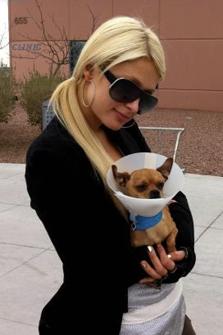
A tiny Chihuahua named Sid has gone from living in an animal shelter in Las Vegas to life in Mulholland Estates in Los Angeles with Paris Hilton. It marks the first time the celebrity has adopted a dog instead of purchasing one from a pet store.

Hilton chose the Lied Animal Foundation, a municipal shelter in Las Vegas, for her community service, per the terms of a plea agreement for a misdemeanor offense committed in Las Vegas. This week, while Hilton spent the day helping at the shelter, she met the 3-year-old former stray and made an instant connection. She arranged to adopt him and, the next day, after Sid had been neutered, which the shelter requires, she returned to take him back to Los Angeles. Sid now lives with Hilton’s two other dogs, a Yorkshire terrier and a Chihuahua.

Hilton commented on Twitter about her work at the shelter, saying, “Volunteered all day at Animal Foundation. Made me cry to see animals needing homes. Adopted a dog today. So sweet.”

According to the Animal Foundation's website, its adoption fee is $155 and includes vaccinations, neutering and a microchip ID. It’s quite a switch from just three years earlier when Paris bragged to an entertainment reporter about buying a tiny dog at a boutique pet store, which was one of the shops Best Friends volunteers rallied at to inform consumers that the puppies in that store came from puppy mills and substandard conditions. The store has since closed its doors.

For Kelli Harmon, campaign specialist for Best Friends Puppies Aren't Products, Hilton’s adoption is hopeful news. “Paris' love for animals has influenced many young people who see her with a tiny Chihuahua and then go buy one for themselves,” Harmon says. “As a fellow Chihuahua adopter, I wish her the best and hope she and her new little one will influence people the same way she has in the past, but that now people will head to the shelter instead of a pet store to find an adorable new pet.”

By the looks of it, Hilton does intend to set an example for others. After she left the shelter, she encouraged her followers on Twitter to adopt rather than buy a pet, writing, “This Christmas, if you’re thinking of getting a dog or cat, get one at your local animal shelter. Save a Life. Don't Shop. Adopt,” and, in a third tweet, “Remember, a dog is for life, not just for Christmas.”

Reprinted courtesy of Best Friends

Nov 13, 2010

It's Official: Puppy Mill Bill Passes

Gypsy the day she was rescued
By Cathy Scott

When I learned the news, on the night of Nov. 2, that the so-called "puppy mill bill" in Missouri had passed, I was elated. That's because sitting next to me was my former puppy mill girl Gypsy. As I wrote an article for Best Friends Animal Society's Web site about the passage of the initiative, which has been called historic, I stopped a few times to both congratulate and hug Gypsy.

I firmly believe that we'll eventually look back and say that Nov. 2, 2010 was the day the puppy mill industry forever changed, and for the better. The bill requires clean water and fresh food, no more than 50 breeding dogs per puppy mill, and no more wire-bottomed cages. Nearly a million Missourians voted "Yes."

It was a year ago this month--November 2009--that Gypsy Rose Lee was pulled from a large puppy mill. She'd had three puppies the week before, and one, two or even all three may still be in that awful place, used as breeders for profit, like my Gypsy.

Gypsy & volunteer Tara Albert
Gypsy is a seven-pound long-haired Chihuahua and as cute as she can be. But the day she arrived at the temporary rescue center, there was a deep sadness in her eyes. She arrived in a carrier with a tiny Pomeranian. They seemed so connected to each other. But, other than arriving from the same puppy mill, they may have never before met each other. In that short time, a few hours in a carrier together as they were transported from a mill by an independent rescuer, the two little dogs had bonded; it was as if they were leaning on each other for support during this scary time. After all, the outside world was all new to them, and they didn't know where they were going or why. Gypsy had lived 2-1/2 years in a wire cage with several other dogs in the only environment she'd ever known.

She had been bred in two different puppy mills, the first of which--a large one--has been listed on HSUS's worst list. She was born there, kept as a breeder instead of leaving with a broker to be shipped cross country to a puppy store. She had one litter by Cesarean section, and the breeder took her to auction to be sold. There, Gypsy was purchased by another breeder, this one a smaller operation with about 200 breeding dogs.

Puppy mill dogs
Gypsy, in early November last year, had a second litter. Once again, they had to take her puppies by C-section. Gypsy didn't nurse her puppies, so they were given to another mama dog. And Gypsy had an infection, so the breeder rejected her. Luckily for Gypsy, an independent rescuer was able to rescue Gypsy and take her to the Best Friends temporary center, through the Puppies Aren't Products program, where Gypsy was one of around 190 dogs fostered by individuals, groups and shelters. And I was lucky enough to be able to take Gypsy home with me. I had her spayed within two days, because she had an infection, a fever and things were not going well. On top of that, she has knee problems (inoperable, because her femur bones are bowed, but keeping her walking and with a good weight helps to ease it).

Gypsy on my lap
Gypsy has adjusted well to her new home. She loves other dogs and fits in well with my crew. Behavior-wise, it's still like she's still anxious and waiting for her new life to end, as if it can't be true that the one she left behind has ended. She continually paws at me--a common trait, which puppy mill dogs get into the habit of doing to the front of their cages. She sleeps against my back each night. I try and reassure her that all is well and nothing is going to change.

She loves her walks and stops to smell nearly every bush and blade of grass as we pass by, because she's fascinated by everything in her new world. She also loves car rides. She's still really shy with new people, won't make eye contact and looks worried when other people hold her.

While I continue working with her and giving TLC, I also just let her be a dog and hang out and do what she enjoys. She deserves no less, as do others still stuck in puppy mills. She loves chewies and practically prances around with them in her mouth.

To all the Gypsys of Missouri still used for profit, hopefully their day too will come sooner than later, now that Proposition B is the law, and they too can get to know the true life of a dog.

Sep 6, 2010

Rock Solid Memories

By Cathy Scott 
Reprinted courtesy of Best Friends Animal Society 

Glance at a painting of a dog named Mia, and her eyes appear to be looking back at you, glistening. Mia is one of the animals now memorialized on painted rocks. Walk around Angels Rest memorial park at Best Friends Animal Sanctuary, and you will see a sampling of those painted rocks.

They’re the work of volunteer Linda David, who has painted more than 1,300 rocks for Best Friends. As Mary Pat Dutton, who worked at Angels Rest until recently, said, “She does it as a hobby that has turned into a labor of love.” 

Mia was my dog, rescued from four feet of water by a Best Friends team in the Gulf following Hurricane Katrina. She passed away from heart disease in 2009 and is buried at Angels Overlook on the Sanctuary grounds. Now, thanks to the generous artistry of Linda, when I look at Mia’s rock, her brown eyes appear to look back at me, her face has that same pouty look she often wore, and it’s like a piece of her is with me again. She was an old soul, and that too was captured in Linda’s portrait. 

“That is my favorite part to paint--the eyes--and I have to put them in near the beginning, and then they start to come alive to me,” she says. “When I see a picture of an animal, I know instantly if I want to paint it. Usually the eyes speak to me, and with a story such as Mia's, I always hope it will find its way to someone who will cherish it."
 
Cherish it, I do, as do others who cared for pets who are now memorialized on stones.

When she finished the latest paintings of animals, Linda suggested they be offered to the employees for whom these animals were extra-special, which is how I was given Mia’s rock. The others were placed at the head of their graves, complimenting the atmosphere at Angels Rest, where, as you walk around to view the graves and the rocks, you hear the sound of 900 chimes in the wind. 

The comments Linda gets back about her paintings is what makes it all worthwhile. “It is so nice to hear from people and to know how much they are enjoying the rocks,” she says. “That is why I do it.”Hand Painted Memorial Rocks 

She’s also done paintings of some of the animals who are still with us, like Georgia. Her story particularly touched Linda, which is why she chose to paint her image. “Georgia is one of the Victory dogs who have gone through so much and can still have so much love in their hearts. That is so amazing to me. They have such inspiring stories that we can all learn from,” she says. 

She also paints a variety of portraits as well as rocks with just the names of the dogs, cats, rabbits, potbellied pigs, horses -- you name it. “Some are the portraits of specific animals, some breeds, and some have things such as hearts and butterflies and names on them,” she says. 

Linda, who had a grooming career for many years, has always loved animals. Once she retired, she was a pet sitter for a few years. “Now I am enjoying painting the rocks, which I started about 10 years ago. I had watercolor lessons many years ago, and my teacher was very inspiring,” she says. Linda and Terry David 

In exchange for her artistry, it’s the response from the people who cared about the pets that is payment enough for her artwork. “One of the biggest compliments I've ever gotten was from a man who lost his dog, Lobo,” Linda says. He said if his house was ever on fire, his Lobo rock would be the first thing he would save. That's all the thanks I need.”

Photos by Molly Wald

May 23, 2010

You Can Go Home Again


"How far we all come. How far we all come away from ourselves. You can never go home again." 
--James Agee


My friend Barb Davis, a photographer in her spare time, shot this beautiful photo of Mia (above) that I just had to share.

The photo was taken in New Orleans when Barb, Carol Guzy and I were there for Best Friends Animal Society's participation in the annual Barkus Parade (a part of Mardi Gras).

It was on that same trip that we took Mia to her previous home, to the American Can Co., a Mid City apartment complex converted from a factory and from where Mia had been rescued.

No one had come forward to claim her, even though her face and her story were on the Internet pretty much everywhere. She was listed on Petfinder as well.

When we pulled into a small parking lot at the front of American Can Apartments on Orleans Avenue, Mia sat up and looked out the window, her head darting in every direction. She looked up at the building, then looked back at me. I lifted her out of the car and she wiggled to be put on the ground. When I did, she practically dragged me on her leash up the steps to the main door. It was locked. She stood there looking up at it, wagging her tail, then looking back at me to open it.

It was quite a moment. Barb was right behind Mia as she pulled me toward the door. "It was so sweet," Barb said. "It was like she wanted to show you where she had lived."

We walked around the large complex of buildings to the back, from where Mia had been rescued on the swimming pool deck from four feet of water. It wasn't until the second rescue day at American Can that the rapid response team members Ethan Gurney and Jeff Popowich could get her and one other Chihuahua from a small corner of dry concrete they'd huddled on. The day before, Mia and two other Chihuahuas swam away from the rescuers.

Once we walked onto the patio deck, Mia wanted to be held. It was obvious she remembered what had gone down there, and her demeanor changed dramatically. She jumped up on my leg to be picked up, so I carried her the rest of the time. We returned to the front of the complex.

We didn't know at the time that Mia had just a little more than a year left to live. Reflecting back now, it was a fitting reunion for her, and a trip to the American Can I'm thankful we made. It was as if Mia had gone full circle, like visiting an old friend. She was home again, and she knew it.

As the five-year anniversary of Hurricane Katrina approaches, rescuers are having their own reunion in New Orleans. And Best Friends, to remember, is posting two stories a week on its Web site, beginning June 1, until the August 30 anniversary.


Who says you can never go home again? On a February day in New Orleans, Louisiana, Mia went home again. And she was happy for it.


My book, Pawprints of Katrina (above), covers Mia's and other stories about the tremendous animal rescue efforts, the largest ever in U.S. history. Read it here.

Photos by Barb Davis. Book cover by Clay Myers.

May 2, 2010

News About My Canine Family

Here are some new photos of my dog family. And I want to share the latest medical news about Rosy (my heeler/basset mix diagnosed 2-1/2 years ago with melanoma) and Gypsy (rescued from a Midwest puppy mill last November).

Gypsy and Rosy just had medical exams. First Gypsy (above). Her patellas -- knee caps -- both luxate. But because her femurs are  bent (a genetic defect), she's not a candidate for surgery.


So, the vet recommended I keep Gypsy exercised and at a good weight for the rest of her life so she doesn't have extra stress on her knees. Gyps conks out sometimes on walks, so the vet also suggested I build her up slowly, push her a little bit more each time until her little legs are more muscular and can take it.
 Now for Rosy (above, running). She has two new moles, one on her bottom and the other on the back of a rear leg. The one on her leg is growing fast, but it's a bright pink and the vet thinks it's a cyst. She wants to remove it anyway, because of Rosy's history. The other is new and in an awkward place, so it's a delicate surgery. I'm still giving Rosy Vitalzym every day, and I just doubled her dose. The vet said she was incredibly healthy for a 10-year-old dog diagnosed more than two years ago with melanoma. She shows no signs of having cancer, so I'm optimistic.

Then there's Joey, my shih tzu (above, left). He just had his teeth cleaned, and no extractions were needed! He's a little trooper and did well. He didn't feel very well, however, that first afternoon and evening. He whimpered a little and sat on my lap. Finally, he fell asleep. When he woke up the next morning, he was a new little man!

Finally, life is good for my big boy, Hollywood, right now, who turned 10 in January. Nothing medical is going on with him! He's lost some weight from all the walks we take -- and watching his food -- and does really well on two-mile runs with me. I think he could go on forever!


Apr 9, 2010

Zoe Means Life

Reprinted from Best Friends Animal Society


By Cathy Scott

It’s a new day for a wire-haired fox terrier named Zoe.

Life was scary at first for this former puppy mill dog. After all, Zoe, who was originally named Cilantro, was born inside a Midwest puppy mill. For the next six-and-a-half years, she was used as a breeder. So, adjusting to life outside a cage was a lengthy process.

It wasn’t always smooth sailing for her adopters, Pamela Clifford and Lorrie Webb, either. In fact, they moved from a condominium to a house because of complaints from neighbors about Zoe and her bark. In a nutshell, adopting Zoe “uprooted our entire life.” But they’re not the kind of people to give up, especially on a dog.


Zoe and Kallie
Zoe and Kallie
It was late May 2009 when Zoe and more than 200 dogs - unwanted, used-up breeders - were rescued and transported to shelters on the East Coast where there’s a high demand for purebred dogs. Around 30, including Zoe, within that group went to Best Friends Animal Sanctuary.

Once at the sanctuary, shy Zoe was diagnosed with mid-level dental disease and her ears were inflamed and dirty. Around that time, Lorrie and her friend Patricia were at the sanctuary attending a workshop. One day at the sanctuary, they spotted Zoe and a cocker spaniel in a run together. They stopped to visit.


“We just had to have her,” Pamela said. A short time later, they returned to the sanctuary to finalize the adoption, and then headed south to La Jolla, Calif., where Zoe went to live with Kallie, a rescued shelter dog, and a cat named Little Girl.


Never having lived in a home, Zoe couldn’t seem to get the hang of housetraining. And, she was frightfully skittish.


That first week, Pamela took time off from work to be with Zoe. “She slept every day,” Pamela said. “Any movement terrified her. She would freeze in her spot. Every time I turned around, she’d freeze.”


Then Zoe was diagnosed with pancreatitis, an inflammation or infection of the pancreas. “We thought we were going to lose her. We went to emergency. We put her on antibiotics and changed her food to high-end dehydrated,” she said.


Also, Pam said, “She was a special-needs dog. I had no idea that it would be the amount of work it was and the patience it would take.”


The first time Zoe was groomed was an experience for everybody involved. “Who would have ever thought a small dog could take down three grown women?” Pamela said. “Oh, those nails she had.”


Next, “Our little Zoe started to bark” - so much so, they unfortunately learned, that when Pamela and Lorrie were at work, she barked nonstop. A few months later, they decided to move into a house in nearby Pont Loma, a coastal community in San Diego.

Life's a beach
Life's a beach
With hard work, patience and time, Zoe gained confidence - and manners. Ten months later, she now loves to take walks along the tide pools near La Jolla Cove, play with toys and wrestle with Kallie. “She’s not barking,” Pamela said. “We come home and everybody’s quiet and calm.”

She’s still a bit afraid of men but is learning to be bolder. When asked if Zoe had adjusted well to life in a home, Pamela said, “I don’t know if she’s well-adjusted or if we’re just in love with her.”


The love Zoe is getting is exactly what makes it all worthwhile for people like Kelli Ohrtman, a specialist for Best Friends’ Puppies Aren’t Products campaign who organizes and oversees the Pup My Ride program.


“The progress Zoe has made with her new family is what keeps us all going,” Kelli said. “Zoe - and the thousands of other dogs like her - is the reason this work is so important.”


“Until she was rescued through Pup My Ride,” Kelli continued, “her life was very small. She was confined to a small cage with no love, no playtime, no freedom to act like a dog. The transition from that small life to living in a home can be difficult. Even accepting love from humans can be difficult for dogs who haven’t ever been given that. But with time, patience and understanding, these dogs blossom.”


Seeing Zoe today “prance around with her friend, snuggle on the couch and run on the beach is the sort of happy ending that makes this work worth it,” she said.

For Pamela and Lorrie, they believe they’ve learned volumes from Zoe and gotten back more than they’ve given.

“If you’ve never seen resilience, she’s the epitome of it,” Pamela said. “Every day she [had] looked sad. It's remarkable she survived what she’s been through.”


Then, one day, a miracle happened. Zoe wagged her tail.


“The first time her tail wagged,” she said, “we were so ecstatic. We said to each other, ‘Look at that.’ It was like watching a baby take her first steps. Zoe is just amazing.”


Photos courtesy of Pamela Clifford and Lorrie Webb.


To view a video of Zoe and family, click here.

Jan 16, 2010

Pawprints of Katrina Book Launch Revisited

The following is a reprint from Las Vegas freelance writer Terrisa Meeks's blog. She not only attended the Pawprints of Katrina book launch and signing--featuring actress Ali MacGraw, who wrote the book's foreword, photographer Clay Myers, and Cathy, along with Katrina dogs Lois Lane and Mia--but Terrisa wrote about it as well. You'll enjoy who she met along the way.

On July 26, Las Vegas author Cathy Scott held a book launch for her most recent book, Pawprints of Katrina: Pets Saved and Lessons Learned, at the Best Friends Animal Sanctuary, located just outside Kanab, Utah. The sanctuary’s Visitor’s Center is the beautiful place you see in this picture. Back in Hollywood’s earlier days, this area was an outpost for filmmakers. (According to IMDb, 26 movies were filmed at the Kanab Movie Ranch, which was formerly located here.) Cathy is a journalist with an impressive background, a true reporter who I’ve found has a keen eye and a determination to uncover the facts. She was on the ground in the Gulf after Katrina, working with the dedicated volunteers and staff of Best Friends to help rescue the animals left behind, stranded, and separated from their families—and to document their stories, which she tells us now in Pawprints. The first person who read my copy was my mother-in-law. (Hey, she agreed to babysit overnight, so she got first dibs on the book.) I asked her yesterday what she thought. She told me she’d had no idea how bad it was for the animals after Katrina. “So I take it that means I should read this book with tissue nearby?” I asked her. “Oh yeah,” she said. “But it’s not because all of it’s sad. It’s also touching.” So, animal lovers, you’ve been warned. Pick up an extra box of Puffs next time you’re at the store.
I have to confess that my husband and I were so enchanted with the sanctuary that we didn’t spend much time at the book launch after we bought our copy of Pawprints. Sprocket the potbellied pig (isn't he adorable?) was standing outside, so we hung out with him. We looked at the line for the book signing, and then we wandered back toward the koi pond, a picturesque scene complete with blooming lily pads. The horse corrals beckoned in the distance. An inviting walk
way wound past the front of the Visitor’s Center, where the hummingbird feeders were
attracting more hummingbirds than I have ever seen in one location. Soon, my husband and I were meandering down the walkway, toward the corrals with the goats and horses. What can I say? We didn’t meet Ali McGraw, who wrote Cathy’s foreword, but take a look at photos of some of the beauties we met instead.
Photos courtesy of Terrisa Meeks.

Dec 24, 2009

Gypsy Rose Lee, a Refugee From a Puppy Mill Comes Home

Meet Gypsy, a tiny survivor from a commercial breeding farm.

In mid November, I went on assignment to the Midwest to cover the rescue of 150 dogs who were scheduled to be killed at puppy mills. They no longer could produce, or they had terrible medical issues, or they were just older, used-up breeders. They're going to leave the puppy mill either feet first or head first, so Best Friends Animal Society's Pup My Ride transport program was there to take them as rescuers pulled them from the commercial breeding farms.

On the first day, we got in around 40 dogs -- every breed you can think of, including two large bull mastiffs, French bulldogs, silkies, Yorkshire terriers, doxies and lots of shih-tzus and King Charles spaniels. Each and every one has his or her own story, and when they come in to a temporary receiving area, literally straight from the puppy mills, their eyes are big and they're just waiting for something bad to happen to them. It's sad, but as each day goes on and they realize that the lives they were forced to live as breeders in wire-bottomed cages, with no air conditioning and no heat, are over, they begin to blossom.

I noticed a 5-1/2-pound long-haired Chihuahua that first day. Her eyes, too, were wide. She wouldn't make eye contact with the volunteers and staff tasked with caring for them, feeding them, cleaning up after them and providing medical exams and vaccinations so they could go out to rescue groups in New York to be adopted out.

Gypsy caught my eye for two reasons: Even though she was just 2 years old, she looked as if she were an old soul; and, secondly, she seemed so sweet, plus absolutely beautiful. I do favor the Chihuahua appleheads. There's just something about them, and, probably, because Mia was an applehead, that's a big reason why I gravitate toward them. They have calm dispositions and are just plain sweet.

I paid attention to which stall -- in a large equestrian barn where we were set up for five days -- the little Chihuahua was assigned to I visited her that evening, after all the vaccinations and med work were done, and went to her large kennel where she was housed with a tiny pomeranian. They had arrived in the same transport crate and came from the same breeder. I took the Chihuahua out of the kennel and held her, but she wiggled and wouldn't look at me. She just wanted to go back and be with her little friend.

The next morning, when we arrived there early, she was still sleeping. I helped clean up the kennels in that stall so I could spend more time with her. She didn't want out of the kennel to walk around. I took her out, though, and she stumbled back in. One of her back legs didn't seem to be working right.

When there was some down time that afternoon, I took her out and sat her on my lap while I wrote an article on my lapstop, wrapping her in a towel so she'd be warm. She was getting more tolerant of me holding her and even started to fall asleep. Progress. Volunteers stopped to pet her. I asked for suggestions on names, and one volunteer said she thought she seemed like a gypsy, because in the mill she was homeless, plus she'd already traveled to our temporary kennels, then she was headed for New York and eventually Las Vegas with me. Gypsy Rose Lee fits her, the volunteer said. So Gypsy it was.

She had a large incision and the breeder told the rescuer that she'd just had three puppies born via C-section a week and a half earlier, that she didn't produce milk and wouldn't take care of her babies. The three puppies were feeding off of another mama dog.

I adopted Gypsy from the rescuer. Then, the next day, three of us -- Kelli Ohrtman, campaign specialist for Best Friends' Puppies Aren't Products, and Best Friends' photographer Gary Kalpakoff -- drove in a mini van following the transport trailer with 164 dogs inside (very nice accomodations in a customized trailer) to New York state, where rescue groups--that had potential adopters who want small breed dogs but want rescued dogs and not puppy store dogs--were waiting. Dr. Sarah Alward with Animal Rescue Fund of the Hamptons was waiting for us too, to help transport animals to her shelter. She examined Gypsy; I was worried about her (she was bleeding). She said her uterus felt firm toward the back and suggested I get her spayed immediately.

I arrived home on a Friday, and the next morning, I took Gypsy into the new Spay and Neuter Center of Southern Nevada. The vet said it looked like this was her second C-section and that it wasn't a very good job. She had pyametra -- an infection in her uterus -- which spaying her solved.

Within a week, Gypsy was feeling well and starting to play with toys! She was awkward at first, but then caught on when I squeaked the toys. She now loves to shake them and carry them all over the house. The first week, she was still shy. Every day she gets braver. I have to be careful not to approach her too quickly because she'll sometimes let out a squeal, like she thinks I'm going to hurt her. She and my shih-tzu Joey are buddies. And she and Rosy, my basset-healer mix, started playing with each other for the first time yesterday. She absolutely loves running out of the dog door, making a run around the yard, then running back inside. Her patellas on both knees are luxated, and one of her legs turns in, but she's getting stronger and stronger. She's still a little scared to ride in the car, but she's getting more used to that too.

She's a funny little dog with a sweet personalit who's a bit awkward, because everything is so new to her. She'll sit and watch TV for 10 minutes at a time, totally entranced. She sleeps against me every night and seems to take comfort in the closeness. She gets so excited when it's time to go to bed, and she crawls under the covers to get warm. I can't imagine what life for this little girl was like for two years in a cold, wire cage. What I do know is she gets a kick out of living in a home. It's amazing watching her. When she tastes something new, like yogurt, for example, she wags her tail and looks up at me, so happy, as if she's saying "thank you," because she can't believe how good it tastes.

I'll give you progress reports as she blossoms and comes out of her shell even more. We're going to my sister's house for Christmas in San Diego and we'll take photos. It's the second time she'll have been there. She was housetrained from the start -- always a surprise to me when a puppy mill dog can be trained so easily and quickly -- so she's no problem as a house guest. She and Joey will be with me, and Rosy is being boarded (only for two days). So stay tuned with reports about Gypsy Rose Lee's new life after a puppy mill! In the meantime, Happy Holidays to all!

Dec 23, 2009

Fun in the Utah Snow


Rosy, my heeler/basset mix, and Joey, my shih-tzu boy, played in the snow last weekend at Angel's Overlook at Best Friends Animal Sanctuary. The sun was out and the snow was on the ground; Rosy couldn't resist playing in it, and then Joey joined in on the fun.

We'd gone to the Overlook to visit the grave sites of Mia, my little Katrina girl who passed away in June, and Molly, the first dog I adopted from Best Friends, who passed away in March 2009. Mia's site was completely under snow but Molly's is pictured here.

Rosy located Molly's site almost immediately. She walked from row to row, looking for her, which I find amazing when she does it, especially after all this time. They were joined at the hip, and no dog mourned more for another than Rosy. Today, she's a happy, healthy, nearly 10-year-old girl. Despite being diagnosed more than two years ago with melanoma, she shows no signs of cancer.

The Overlook is a beautiful spot and a great one to visit and remember the two canine girls I've lost.

Joey (pictured left) is still recovering from his injuries (it's a long story) and is doing phenomenally well. He still sleeps a lot and gets cold easily (thus the hoodie he wore in the snow), but he's almost fully recovered, just 3-1/2 weeks later. The vets at both Las Vegas Animal Emergency Hospital, overnight, and Durango Animal Hospital, from 7 a.m. to closing, did an incredible job saving him over a 24-hour period. He's one lucky dog. But I consider myself the lucky one that he made it. He's a sweet, smart dog with a wonderful spirit--and a very large will to live!

Enjoy the pics, and have a great holiday!

Photos by Jennifer Hayes

Mar 1, 2009

Well, hello, Dolly!

Mia has another new friend, this one a special needs partially paralyzed chihuahua -- and Mia's none too thrilled about it. That's because Dolly is still a puppy and wants to chew on Mia's legs and play nonstop (it's easy to tell Dolly's paralysis doesn't hold her back from much). We're looking for a forever home for Dolly. Here's a story, below, I wrote about her for Best Friends Animal Society's Web site. I'm also including an adorable video of Dolly that will make you laugh. Tiny rescued dog displays a big heart By Cathy Scott, Best Friends staff writer (Courtesty of Best Friends) A tiny paralyzed puppy -- found all alone on a city sidewalk -- has a new lease on life, all because of a kind veterinarian and Best Friends volunteers. Dolly, a partially paralyzed long-haired chihuahua, was found last October abandoned on a street in Riverside County, California. Just two months old, she was taken to an animal shelter, where a volunteer veterinarian was asked to put her down because of her paralysis. “The staff fell in love with her, but she was deemed special circumstances due to her legs,” Dr. Ron Friedlander says. “Her greatest feature was her attitude; she did not know she was not a normal dog.” Because she weighed around just three pounds at the time, she was kept in the shelter’s receiving area. “Many people were able to play with her,” Friedlander says. “She would sit in the palm of your hand and try to lick your face. If you put her on the floor, she would scoot across the shelter almost as fast as a normal dog.” Once the shelter’s five-day hold was up and no one had applied to adopt Dolly (previously known as Twinkle), Friedlander took her to his emergency veterinary clinic. Three days later, Catherine Macias, who volunteers with Best Friends’ Los Angeles Programs, walked into the clinic and was told about Dolly. She found a temporary foster home for her. Because of a sore on her leg that turned gangrene, Friedlander removed one of Dolly’s rear legs. Now, because there’s no possibility of rehabilitating her remaining rear leg, that too is being amputated, so she can scoot around better without the leg -- which is straight and in front of her -- getting in the way. In Las Vegas, Cassandra Schneller took Dolly in to care for her following the surgery. “She has an enormous heart in such a tiny dog,” Schneller says. She took Dolly to work – diapers and all. “I brought her with me to work every day and any public place that allowed dogs,” she says. “Dolly had a passion for life and loved every part of it -- people, dogs, toys, treats, outings. If she wasn’t in someone’s arms, she was moving faster than I could keep up with her.” While with Schneller, she even learned to play fetch. Now, Dolly is staying with my dogs and me. The exposure to and affection from people she received from the moment she was plucked off the streets has paid off. She’s a happy, active, well adjusted six month old who adores people and other dogs equally. The one thing missing in Dolly’s life is a forever home with someone who has experience and is dedicated with caring for an incontinent, disabled dog who needs regular diaper changes. “Her good looks and charms make it impossible to not want the best for this little doll,” Schneller says. Click on the image to the right to see a video of Dolly in action.

Jan 14, 2009

Who's the Boss?

Boss, Mia's temporary playmate for 6 weeks, finds a new home By Cathy Scott (Reprinted with permission from Best Friends Web site) Boss the Chihuahua faced a sure death sentence if sent back to the pound for misbehaving after he was adopted by an elderly person in an assisted-living home. Terrified of wheelchairs and walkers, 2-year-old Boss was “terrorizing” residents at the Las Vegas facility, where he’d lived for just two months, according to the home’s manager. He had to go. The day before he was to be returned to the shelter, however, a plea for help was issued from Oli Lewis with Sin City St. Bernard Rescue, who heard about Boss’s plight. Lewis couldn’t take in a small dog because of the enormous size of her St. Bernards, so she called me and I picked up Boss at the eleventh hour and took him home to foster. Boss was given his name because he was, to put it mildly, bossy. He was terrified of large dogs, new people and, especially, wheelchairs and walkers. When he was in what he perceived to be a frightening environment, his way of coping was to lunge, bark and bare his teeth. Sherry Woodard, Best Friends’ animal behavior consultant, evaluated the tiny dog to help me guide him past that behavior. When told that Boss was affectionate and sweet toward his 85-year-old former person, Woodard said, “That is who he really is.” The other behavior, she said, was a defense mechanism. Woodard suggested that Boss be allowed to get used to his foster environment, away from the noisy assisted-living home, and just be allowed to be a dog. His elderly person’s reaction when he barked had been to hit him. When he first met Woodard and barked at her, he didn’t get a reaction, other than positive words. Woodard described him as clearly confused and trying to cope in the environment he was forced to live in. Luke, Boss and Lydia In his foster home, I gave him reassurance and affection coupled with regular walks, a few hikes, trips to PetSmart and Petco, and rides in the car to drive-through restaurants – all to help him acclimate to new things and new people. Slowly, his fear disappeared and Boss became a happy, playful dog. Even better, six weeks after leaving the assisted-living facility, Boss has found a forever home with a family in St. George, Utah. He’s an example, Woodard says, that pet behavior can change with time and positive training, which is one of the goals of a No More Homeless Pets campaign to find pets forever homes. “Defensive behavior based in fear is so common in the dogs I meet,” Woodard says. “They need help to learn how to enjoy their opportunities for relaxing and enjoying a better life.” Today, Boss has that new opportunity for a better life with teenagers Lydia and Luke and their father, Dan Oliver. When Boss arrived at his new home, he was happy to be there, wagging his tail and looking up at his new family. The first thing they did was to take him shopping for a winter jacket. “He’s going to be the best-dressed dog in Utah,” Oliver says. Photo of Boss by Gary Kalpakoff Photo of Luke, Boss and Lydia by Dan Oliver