By Cathy Scott
Reprinted courtesy of Best Friends Animal Society
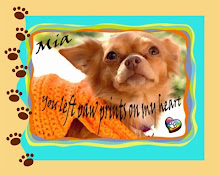
Glance at a painting of a dog named Mia, and her eyes appear to be looking back at you, glistening. Mia is one of the animals now memorialized on painted rocks. Walk around Angels Rest memorial park at Best Friends Animal Sanctuary, and you will see a sampling of those painted rocks.
They’re the work of volunteer Linda David, who has painted more than 1,300 rocks for Best Friends. As Mary Pat Dutton, who worked at Angels Rest until recently, said, “She does it as a hobby that has turned into a labor of love.”
Mia was my dog, rescued from four feet of water by a Best Friends team in the Gulf following Hurricane Katrina. She passed away from heart disease in 2009 and is buried at Angels Overlook on the Sanctuary grounds. Now, thanks to the generous artistry of Linda, when I look at Mia’s rock, her brown eyes appear to look back at me, her face has that same pouty look she often wore, and it’s like a piece of her is with me again. She was an old soul, and that too was captured in Linda’s portrait.
“That is my favorite part to paint--the eyes--and I have to put them in near the beginning, and then they start to come alive to me,” she says. “When I see a picture of an animal, I know instantly if I want to paint it. Usually the eyes speak to me, and with a story such as Mia's, I always hope it will find its way to someone who will cherish it."

Cherish it, I do, as do others who cared for pets who are now memorialized on stones.
When she finished the latest paintings of animals, Linda suggested they be offered to the employees for whom these animals were extra-special, which is how I was given Mia’s rock. The others were placed at the head of their graves, complimenting the atmosphere at Angels Rest, where, as you walk around to view the graves and the rocks, you hear the sound of 900 chimes in the wind.
The comments Linda gets back about her paintings is what makes it all worthwhile. “It is so nice to hear from people and to know how much they are enjoying the rocks,” she says. “That is why I do it.”
She’s also done paintings of some of the animals who are still with us, like Georgia. Her story particularly touched Linda, which is why she chose to paint her image. “Georgia is one of the Victory dogs who have gone through so much and can still have so much love in their hearts. That is so amazing to me. They have such inspiring stories that we can all learn from,” she says.
She also paints a variety of portraits as well as rocks with just the names of the dogs, cats, rabbits, potbellied pigs, horses -- you name it. “Some are the portraits of specific animals, some breeds, and some have things such as hearts and butterflies and names on them,” she says.
Linda, who had a grooming career for many years, has always loved animals. Once she retired, she was a pet sitter for a few years. “Now I am enjoying painting the rocks, which I started about 10 years ago. I had watercolor lessons many years ago, and my teacher was very inspiring,” she says. 
In exchange for her artistry, it’s the response from the people who cared about the pets that is payment enough for her artwork. “One of the biggest compliments I've ever gotten was from a man who lost his dog, Lobo,” Linda says. He said if his house was ever on fire, his Lobo rock would be the first thing he would save. That's all the thanks I need.”
Photos by Molly Wald
Sep 6, 2010
Rock Solid Memories


Sep 4, 2010
Nosey and Me
 |
| Nosey, in a doll stroller, with Cathy (or is that Cordelia?) |
One of my earliest memories is the day our family got a dog. We named her Nosey because she sniffed all around the yard and house when she first came home. She was a pound puppy, and she was loyal.
My twin sister Cordelia and I were 3 years old. I remember one Saturday morning running outside to the front yard and standing there in anticipation as our father pulled up to the curb. He had left that morning for the county pound, but we didn't know it. All we were told was he was coming home with a surprise. At the time, we lived in the Valencia Park community of San Diego, and our street was loaded with kids. Some were there with us, waiting.
Dad walked around to the passenger side of the car and opened the door. I've never forgotten it. Nosey practically fell out of the car, but I'm sure my Dad had carried her down. She didn't have a leash on, but she didn't go anywhere. All five of us -- my brothers and sisters -- started fawning over her. She was the cutest, sweetest little short, black-and-white puppy with floppy ears, part beagle, part Basset hound. I've loved short dogs ever since.
When we moved to La Mesa, a suburb of San Diego, we lived on a cul-de-sac, and Nosey was always outside with us. When we played softball in the traffic circle, she'd stay on the sidewalk as we played. I remember hanging out at our friends' house (Vickie and Sharon, who lived down the street), and Nosey would sit on the lawn in their front yard, waiting for us to come out.
When I was 7, our father won a trip to a convention in Jackson Hole, Wyoming. We drove there, stayed a week, and then went for another week to Missouri, where my father grew up. We left Nosey with family friends, who lived 10 miles away. A couple days into it, Nosey got out and ran away. They looked everywhere and couldn't find her. The father decided to check our house. Sure enough, Nosey had made it home and was hiding in a corner of our basement. He left her at our house and went back each day to check on her and feed her. Nosey had never before been to their house, so it amazed us all that she had found her way home. She was there to greet us when we returned.
When Nosey contracted hepatitis shortly after we moved to La Mesa, when we were still in grade school, the five of us, without our parents, took her to the vet. My brother Michael, the oldest and probably 17 at the time, carried her across the canyon behind our house that led us straight to the nearest veterinary clinic. The vet gave us medicine and said she had to stay there, because she was too sick to go home. He wasn't sure she'd make it. All of us said no, that she was coming home with us. We instinctually knew she had a much better chance at home. And we were right.
Once home, we laid her down on the living room floor on a blanket, where she stayed for about a week, barely moving except to eat some and go outside. I remember that first day, laying my head on the carpeted floor next to her, petting her, and Nosey growling. She wanted to be left alone. So that's what we all did; we gave her space. Within a week, she appeared to be well on the road to recovery. In no time at all, she was back to herself. That illness was probably the only time she ever growled at any of us.

Seeing Nosey as a puppy again in this photo brought back memories. Our mother always called her "the doggie in the window," so she must have been at a window when our father first saw her at the pound (much smaller facilities back then). No wonder all of us kids became animal lovers. Our dad made sure of that when he gave us a puppy -- and, later, Guinea pigs, a parakeet, hamsters, rabbits, fish, a cat, and a horse named Star. Nosey was a member of our family. I still miss her.
Aug 17, 2010
Loss of a Friend

 I've always said that Molly (with Lizzie, left) was a heeler trapped in a basset body. But Lizzie was smaller and in better proportion than Molly. And although Lizzie was short like Molly, she was more like a midget heeler, and a fast one. Most of all, she was very sweet and affectionate -- and smart to boot.
May 23, 2010
You Can Go Home Again


May 2, 2010
News About My Canine Family
 Here are some new photos of my dog family. And I want to share the latest medical news about Rosy (my heeler/basset mix diagnosed 2-1/2 years ago with melanoma) and Gypsy (rescued from a Midwest puppy mill last November).
Gypsy and Rosy just had medical exams. First Gypsy (above). Her patellas -- knee caps -- both luxate. But because her femurs are bent (a genetic defect), she's not a candidate for surgery.

So, the vet recommended I keep Gypsy exercised and at a good weight for the rest of her life so she doesn't have extra stress on her knees. Gyps conks out sometimes on walks, so the vet also suggested I build her up slowly, push her a little bit more each time until her little legs are more muscular and can take it.
 Now for Rosy (above, running). She has two new moles, one on her bottom and the other on the back of a rear leg. The one on her leg is growing fast, but it's a bright pink and the vet thinks it's a cyst. She wants to remove it anyway, because of Rosy's history. The other is new and in an awkward place, so it's a delicate surgery. I'm still giving Rosy Vitalzym every day, and I just doubled her dose. The vet said she was incredibly healthy for a 10-year-old dog diagnosed more than two years ago with melanoma. She shows no signs of having cancer, so I'm optimistic.
 Then there's Joey, my shih tzu (above, left). He just had his teeth cleaned, and no extractions were needed! He's a little trooper and did well. He didn't feel very well, however, that first afternoon and evening. He whimpered a little and sat on my lap. Finally, he fell asleep. When he woke up the next morning, he was a new little man!
Finally, life is good for my big boy, Hollywood, right now, who turned 10 in January. Nothing medical is going on with him! He's lost some weight from all the walks we take -- and watching his food -- and does really well on two-mile runs with me. I think he could go on forever!
Apr 13, 2010
Natural Treatment for a Dog's Sniffles
 My shih-tzu Joey's right eye is swollen again and he's congested; he has a rattle when he breathes, and his nose is congested and drippy. His eye was swollen when he was rescued more than a year ago, and it comes and goes.
So, I thought I'd try Vitalzym on him this time. I give it daily to Rosy, my basset-heeler mix, who has malignant dermal melanoma (and two-and-a-half years after diagnosis appears strong and healthy).
Vitalzym is loaded with systemic enzymes that -- as one Web site put it -- "act like little Pac-Mans that go around 'munching' mucus, inflammation, fibrin, viruses and scar tissue in the body."
I'm hoping it will work as an anti-inflammatory for congestion too. We'll see. Joey's been under the weather all day, so it might be allergies. The weather here in the Mojave Desert is up and down right now temperature-wise, plus it's been really windy. Fingers and paws crossed it helps. Will keep you posted!
Apr 9, 2010
Zoe Means Life

By Cathy Scott
It’s a new day for a wire-haired fox terrier named Zoe.
Life was scary at first for this former puppy mill dog. After all, Zoe, who was originally named Cilantro, was born inside a Midwest puppy mill. For the next six-and-a-half years, she was used as a breeder. So, adjusting to life outside a cage was a lengthy process.
It wasn’t always smooth sailing for her adopters, Pamela Clifford and Lorrie Webb, either. In fact, they moved from a condominium to a house because of complaints from neighbors about Zoe and her bark. In a nutshell, adopting Zoe “uprooted our entire life.” But they’re not the kind of people to give up, especially on a dog.
 |
Zoe and Kallie |
Once at the sanctuary, shy Zoe was diagnosed with mid-level dental disease and her ears were inflamed and dirty. Around that time, Lorrie and her friend Patricia were at the sanctuary attending a workshop. One day at the sanctuary, they spotted Zoe and a cocker spaniel in a run together. They stopped to visit.
“We just had to have her,” Pamela said. A short time later, they returned to the sanctuary to finalize the adoption, and then headed south to La Jolla, Calif., where Zoe went to live with Kallie, a rescued shelter dog, and a cat named Little Girl.
Never having lived in a home, Zoe couldn’t seem to get the hang of housetraining. And, she was frightfully skittish.
That first week, Pamela took time off from work to be with Zoe. “She slept every day,” Pamela said. “Any movement terrified her. She would freeze in her spot. Every time I turned around, she’d freeze.”
Then Zoe was diagnosed with pancreatitis, an inflammation or infection of the pancreas. “We thought we were going to lose her. We went to emergency. We put her on antibiotics and changed her food to high-end dehydrated,” she said.
Also, Pam said, “She was a special-needs dog. I had no idea that it would be the amount of work it was and the patience it would take.”
The first time Zoe was groomed was an experience for everybody involved. “Who would have ever thought a small dog could take down three grown women?” Pamela said. “Oh, those nails she had.”
Next, “Our little Zoe started to bark” - so much so, they unfortunately learned, that when Pamela and Lorrie were at work, she barked nonstop. A few months later, they decided to move into a house in nearby Pont Loma, a coastal community in San Diego.
 |
Life's a beach |
She’s still a bit afraid of men but is learning to be bolder. When asked if Zoe had adjusted well to life in a home, Pamela said, “I don’t know if she’s well-adjusted or if we’re just in love with her.”
The love Zoe is getting is exactly what makes it all worthwhile for people like Kelli Ohrtman, a specialist for Best Friends’ Puppies Aren’t Products campaign who organizes and oversees the Pup My Ride program.
“The progress Zoe has made with her new family is what keeps us all going,” Kelli said. “Zoe - and the thousands of other dogs like her - is the reason this work is so important.”
“Until she was rescued through Pup My Ride,” Kelli continued, “her life was very small. She was confined to a small cage with no love, no playtime, no freedom to act like a dog. The transition from that small life to living in a home can be difficult. Even accepting love from humans can be difficult for dogs who haven’t ever been given that. But with time, patience and understanding, these dogs blossom.”
Seeing Zoe today “prance around with her friend, snuggle on the couch and run on the beach is the sort of happy ending that makes this work worth it,” she said.
For Pamela and Lorrie, they believe they’ve learned volumes from Zoe and gotten back more than they’ve given.
“If you’ve never seen resilience, she’s the epitome of it,” Pamela said. “Every day she [had] looked sad. It's remarkable she survived what she’s been through.”
Then, one day, a miracle happened. Zoe wagged her tail.
“The first time her tail wagged,” she said, “we were so ecstatic. We said to each other, ‘Look at that.’ It was like watching a baby take her first steps. Zoe is just amazing.”
Photos courtesy of Pamela Clifford and Lorrie Webb.
To view a video of Zoe and family, click here.
Mar 11, 2010
The Crew in the 'Hood

Sunday morning was sunny for about a one-hour window, in between the rain in the Mojave Desert. So I got everybody into their harnesses (above left-right, Rosy, Hollywood and Joey), and we hurried out the door for a walk in the 'burbs.
 Gypsy (pictured left) lagged behind a bit, so that's why she's pictured by herself. Once, I tried her on a coupler -- two on one leash -- with Joey, but it was more like Joey was pulling her than she walking at her own speed. So I ended up carrying her most of the way.
She's not up to their level yet. After all, the Gypsy girl is a puppy mill survivor with a back leg that turns in from living in a cramped wire cage for two years. We'll try the coupler again another time. She's a trooper, though, and loves to go on walks. It took just two trips around our neighborhood for her to figure out that it was a really cool thing to do.
Gypsy now gets just excited as my other dogs when the harnesses and leashes come out and it's time to get "dressed."
Passers-by in cars sometimes slow down to look at the small, medium and extra-large dogs I'm basically steering down the sidewalk. Some even make comments like, "Boy, that's a handful." It looks like it, but they're not. They all know the drill, are great on leashes and love their walks -- and I have just as much fun as they do.
Feb 17, 2010
Jesse James, Sandra Bullock Reunite with Missing Dog After 3 Weeks
Reprinted from news reports: Jesse James' dog, Cinnabun, has been returned home. "The search is over!," James posted on his West Coast Choppers Web site Wednesday, Feb. 17. "We got a call from a gal by the name of Rosaura in Los Angeles today saying she had Cinny." Rosaura brought Cinnabun--who disappeared from the shop Jan. 25--to the West Coast Choppers office for the reunion, James wrote in his post. "The car pulls in, the door flings open, and out pops Cinnabun! It's been just over three weeks since we last saw her and were starting to wonder if we'd ever get her back ... and there she was," he wrote. Cinnabun had reportedly been with the woman then entire time. She wasn't aware who Cinnabun belonged to until she saw a flier, which were posted throughout the Los Angeles area. Photos of the reunion between the West Coast Choppers owner and his puppy pitbull are posted on the West Coast Choppers Web site. James wrote that Cinnabun was in good shape, "...maybe a few pounds thinner than when she left. But super happy to be home. We're taking her to the vet to get her all checked out and chipped, and GPS'd, and live-tracked by Google Earth...the works. We don't want to lose this little gal again!!!" Following Cinnabun's disappearance near Anaheim Street and the Los Angeles River, James posted Twitter messages pleading for help in finding his lost dog. James and wife, actress Sandra Bullock, also posted a $2,000 reward, then later increased it to $5,000 for Cinnabun's safe return. "Thanks to everyone who sent us e-mails, calls, and well wishes over the past few weeks," James wrote on the West Coast Choppers Web site, "and a BIG thanks to Rosaura in Los Angeles who found her and brought her back ... and a special thanks from Mr.T who is happy to have his little buddy back. "Let the barking, wrastlin' and bone chasing begin!"
Jan 16, 2010
Pawprints of Katrina Book Launch Revisited
The following is a reprint from Las Vegas freelance writer Terrisa Meeks's blog. She not only attended the Pawprints of Katrina book launch and signing--featuring actress Ali MacGraw, who wrote the book's foreword, photographer Clay Myers, and Cathy, along with Katrina dogs Lois Lane and Mia--but Terrisa wrote about it as well. You'll enjoy who she met along the way.


Dec 28, 2009
Home for the Holidays: Sissy & Peanut Adopted
 The last few months, I fostered two puppies (they were together a few weeks – overlapped). The first one was Sissy, a long-haired Chihuahua rescued from a large commercial breeder in Southern California who was days from being evicted and he unloaded Sissy and some mama dogs. She weighed just a pound when she arrived.
 Sissy was adopted by Laurie Ray in Del Mar, who, with her husband, adores her. Sissy -- now named Missy – is never alone because of a live-in housekeeper, plus Laurie takes her just about everywhere she goes. She spent the Christmas holiday with them in Oregon. One compliment they’ve given is how well trained she is for a puppy. One thing I try to do is teach my fosters basic commands – sit, stay, up, down, off, etc. It's nice to hear it paid off.
 Then came Peanut, a 3-month-old papillon puppy, who had been confiscated by animal control from a man who was tossing out food to the back yard every three days. An Arizona rescue group, who had no place for her, asked me to take her. I drove to Kingman, Ariz., on a Saturday morning to meet a volunteer at the halfway point. Peanut was the last of her litter to be confiscation, left alone in a yard for three weeks and only being fed every three days. But she wasn’t skiddish, although she was needy.
"She loves the snow, and I have to make her come in after a short time. She is a love. She sleeps in the bed, sits on my lap and hugs. Missy is doing good with her but gets aggravated with the youngster sometimes. Housetraining is going great. She is still all pup and chews and chases, but we are working on that. I have a friend who is a trainer for agility and we have started training Peanut. She is a very smart girl. She loves everyone who visits and everyone loves her. It is fun to watch her explore new things. She dearly loves her toys and has several in the bed every night. She is a joy and once again I thank you."

Dec 24, 2009
Gypsy Rose Lee, a Refugee From a Puppy Mill Comes Home

 On the first day, we got in around 40 dogs -- every breed you can think of, including two large bull mastiffs, French bulldogs, silkies, Yorkshire terriers, doxies and lots of shih-tzus and King Charles spaniels. Each and every one has his or her own story, and when they come in to a temporary receiving area, literally straight from the puppy mills, their eyes are big and they're just waiting for something bad to happen to them. It's sad, but as each day goes on and they realize that the lives they were forced to live as breeders in wire-bottomed cages, with no air conditioning and no heat, are over, they begin to blossom.
 When there was some down time that afternoon, I took her out and sat her on my lap while I wrote an article on my lapstop, wrapping her in a towel so she'd be warm. She was getting more tolerant of me holding her and even started to fall asleep. Progress. Volunteers stopped to pet her. I asked for suggestions on names, and one volunteer said she thought she seemed like a gypsy, because in the mill she was homeless, plus she'd already traveled to our temporary kennels, then she was headed for New York and eventually Las Vegas with me. Gypsy Rose Lee fits her, the volunteer said. So Gypsy it was.